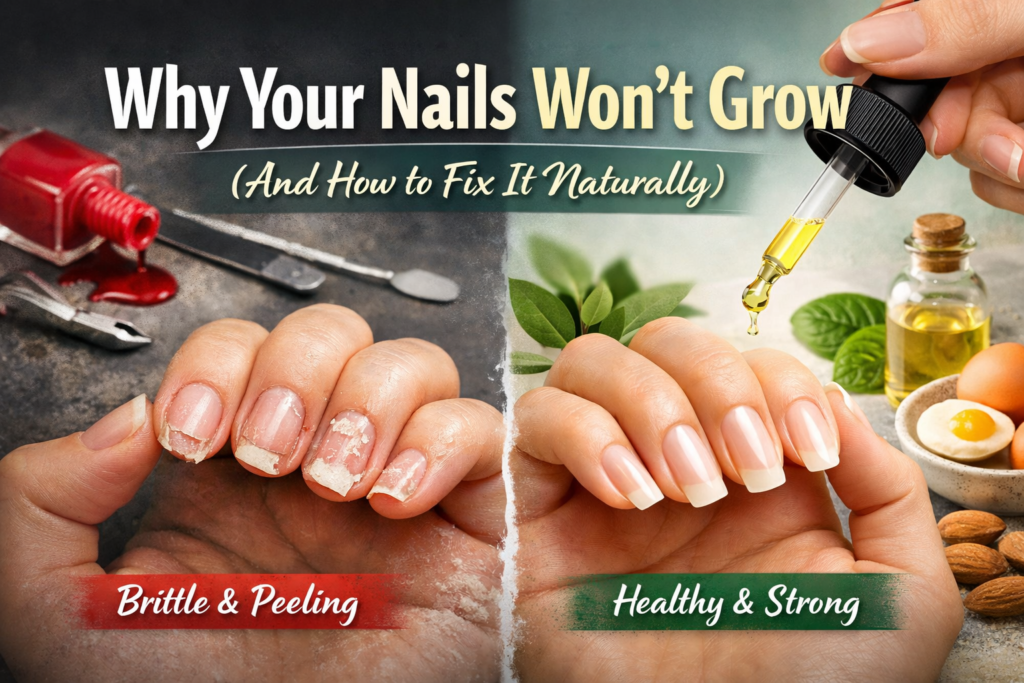
Why Your Nails Won’t Grow (And How to Fix It Naturally)
You look down at your hands, and instead of that sleek, polished look you paid for, you see the aftermath: thinning plates, painful peeling, and nails that refuse to budge past your fingertips. If you are searching for how to grow nails faster naturally, you are likely tired of the endless cycle of “cover and conceal.” To be honest, it’s a frustrating place to be.
The frustration of damaged nails is more than just an aesthetic issue; it is a sign that your nail health has been compromised by harsh chemicals and mechanical trauma. Many women turn to serums or quick-fix hardeners, but these often contain formaldehyde that makes nails brittle over time. In fact, these products can sometimes do more harm than good by masking the underlying weakness.
The truth is that healthy, long nails are not a result of a one-time treatment. They are the product of a dedicated recovery environment. To reclaim your natural strength, you need to stop the damage at the source and support your body’s internal keratin production. This guide will walk you through the science of nail regeneration and provide a proven roadmap for lasting results.
Real Talk: What I Noticed During Recovery
One thing I noticed when I stopped using gels cold turkey was how thin my natural nails actually were. They felt like paper. It’s easy to get discouraged in that first week. However, the turning point usually happens around day 20. That’s when the new, healthy growth at the base starts to feel significantly sturdier than the damaged tips. It’s not an overnight miracle, but seeing that clear line of healthy growth is incredibly satisfying.
Common Nail Recovery Mistakes to Avoid
Before we fix the problem, we must stop the habits that are sabotaging your progress. Many women inadvertently stall their growth by following advice that sounds good but actually hurts the nail matrix.
- Over-buffing the nail plate: Sanding down the ridges might make nails look smooth, but it thins the plate significantly.
- Using harsh “hardeners”: Most drugstore hardeners use formaldehyde to cross-link keratin. This makes the nail very hard but extremely brittle, leading to snaps.
- Peeling off gel polish: This “satisfying” habit rips away the top layers of your nail cells, leaving the plate raw.
- Skipping cuticle care: The cuticle is the guardian of the nail. Ignoring it leads to a “choked” matrix where growth slows down.
- Ignoring hydration: Nails are porous. If they aren’t hydrated with oil, they will soak up water, causing them to swell and shrink, which leads to peeling.
How to Grow Nails Faster Naturally: Your 6-Step Recovery Routine
If you want to see real changes, you must treat your nails like a skin-care routine. Consistency is the only way to see a difference in the months it takes for a full nail to grow out.
1. Stop Aggressive Treatments
The first step is a “nail detox.” Pause the gels, acrylics, and dip powders for at least 8 to 12 weeks. Your nails need to breathe and regain their natural oil balance.
2. Trim and Reshape Safely
Long, damaged nails are prone to snagging. Keep your nails short during the first phase of recovery. Use a glass file to seal the keratin layers at the edge.
3. Hydrate (The Cuticle Oil Protocol)
Apply a high-quality oil to your cuticles at least three times a day. The oil penetrates the nail plate to keep it flexible and acts as a “glue” for the nail layers.
4. Use a Strengthening Base Coat
Instead of a harsh hardener, use a treatment base coat enriched with AHAs or hexanal. These help to strengthen bonds without making them stiff.
5. Protect from Water Damage
Water is actually the enemy of weak nails. Wear gloves when washing dishes. Excessive water exposure causes the nail to expand and contract, weakening the structure.
6. Support Internal Nutrition
Your nails are a reflection of your internal health. Focus on foods like eggs (biotin), spinach (iron), and lentils (zinc) to provide the building blocks for keratin.
The “Water Test” for Nail Health
Curious about how damaged your nails really are? Try this: put a drop of water on your bare nail plate. If the water beads up, your nail’s lipid barrier is somewhat intact. If the water soaks in immediately and the nail turns translucent or soft, your nail is highly porous and lacks the natural oils needed for protection. This is a clear sign you need to ramp up your oil application immediately.
The Science of Nail Growth: Expert-Backed Advice
Understanding the biology of your hands changes how you treat them. The nail plate is made of translucent keratin, a protein also found in your hair and skin.
The Nail Growth Cycle
A fingernail grows an average of 3.5 millimeters per month. This means if you have damage at the base, it will take several months to see that damage “grow out.” Patience is the most important ingredient here.
Biotin for Nails: Does it Work?
Biotin, or Vitamin B7, is well-studied for nail growth. It helps the body metabolize amino acids that produce keratin. Clinical studies have shown consistent supplementation can increase nail thickness by up to 25% for some people.
Product Type Comparison: Repair vs. Traditional
| Product Type | Repair Strength | Toxicity Level | Longevity Score |
|---|---|---|---|
| Traditional Hardener | High (Immediate) | High | 3/10 |
| Jojoba Cuticle Oil | Medium (Cumulative) | Zero | 10/10 |
| Glass Nail File | High (Preventative) | Zero | 9/10 |
| Biotin Supplements | High (Internal) | Low | 9/10 |
Clean Nail Care Swaps for Stronger Natural Nails
To grow nails faster naturally, you must upgrade your toolkit. Traditional tools and chemicals are often too abrasive for recovering nails. Here are some better alternatives:
- Glass Nail Files vs. Emery Boards: Traditional boards create microscopic tears. A glass file grinds the nail down smoothly, sealing the edge.
- Soy-Based Removers: These take slightly longer to work but do not dehydrate the nail plate like acetone does.
- 10-Free Formulas: Switch to polishes that avoid the most common irritants and toxins.
- Quality Cuticle Oil: Look for Jojoba oil (which mimics natural sebum) and Vitamin E. Avoid mineral oil, which just sits on the surface.
Safety and Longevity Considerations
Pregnancy-Safe Options
If you are pregnant, avoiding phthalates and toluene is critical. Stick to water-based polishes or high-quality “21-free” brands to ensure safety for both you and your baby.
Sensitive Skin Guidance
If you have eczema around the nail, avoid any products with synthetic fragrances. Use pure, cold-pressed oils to soothe inflammation without causing a flare-up.
FAQ: Frequently Asked Questions
How long does it take to repair damaged nails after acrylics?
It typically takes 3 to 6 months to fully grow out the damaged portion. You will see initial improvements in strength within 2 to 4 weeks of consistent oiling.
Can nails fully recover from gel damage?
Yes, nails are constantly regenerating. As long as the nail matrix hasn’t been permanently scarred, your nails will eventually grow back healthy.
Should I stop wearing polish during nail recovery?
While it’s best to go “naked” to allow for maximum oil absorption, you can wear a non-toxic, breathable treatment polish if you prefer the look of covered nails.
Conclusion: Healthy Nails Are Rebuilt—Not Rushed
Learning how to grow nails faster naturally is a journey of patience and self-care. There are no shortcuts to biological growth, but by removing the barriers of toxic chemicals, you allow your body to do what it does best: heal.
The transition from damaged, thin nails to a strong, natural set is incredibly rewarding. Remember that your nails are a living part of your body that requires hydration, nutrition, and protection. Stop hiding your hands and start your recovery today.